
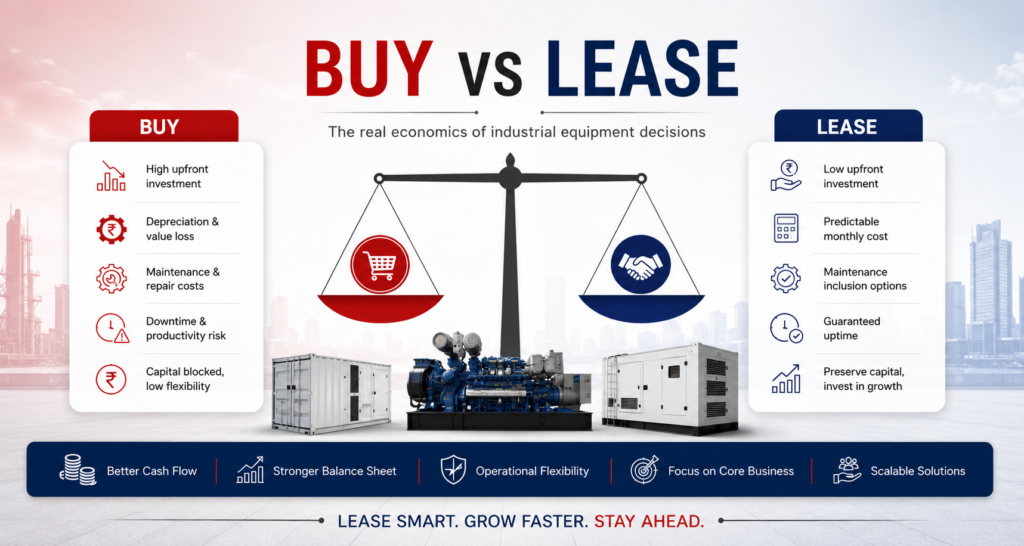
For plant managers, procurement heads, and CFOs across Oil & Gas, Power, Infrastructure, Mining, and Manufacturing, the “Buy vs Lease” decision usually gets treated as a simple math problem: which number is smaller? In practice, it’s a capital structure decision, a risk decision, and an operations decision all at once — and the sticker price is often the least important number in it.
Here’s how to actually think through it.
1. The Purchase Price Is Not the Cost
When a business buys a genset, crane, or compressor outright, the invoice amount is just the entry ticket. The real cost accumulates over the asset’s working life:
- Depreciation — the asset loses book value every year, whether it’s running or idle.
- Maintenance and spares — scheduled servicing, unscheduled breakdowns, and the technician time both require.
- Downtime cost — every hour an owned asset is under repair is an hour your project isn’t earning.
- Obsolescence — emission norms, efficiency standards, and technology all move forward; owned assets age in place.
- Storage and idle-time cost — equipment bought for peak season sits as dead capital the rest of the year.
A leased asset folds most of these into a single predictable monthly number. That’s not a marketing line — it’s a straightforward shift of risk from your balance sheet to the lessor’s.
2. Running the ROI Comparison Properly
A fair buy-vs-lease comparison has to look at Total Cost of Ownership (TCO) over the same time horizon, not just the upfront price versus the monthly lease rate. A simplified 5-year framework looks like this:
Owning: Purchase price + annual maintenance + estimated breakdown/downtime cost + resale value (subtracted) = Total Cost of Ownership
Leasing: Monthly lease rate × tenure + any service add-ons (minus) uptime guarantee value = Total Cost of Leasing
The two numbers are often closer than people expect on paper. Where leasing usually pulls ahead is in the variables that are hard to put a number on until something goes wrong: an unplanned breakdown during a production run, a compliance upgrade that makes an owned asset non-compliant mid-life, or a project that runs shorter than expected and leaves you holding an asset with no next job.
The right question isn’t “which costs less on a spreadsheet” — it’s “which option costs less across the range of outcomes that could actually happen.” Leasing narrows that range. Owning widens it.
3. Tax and Balance-Sheet Benefits
This is where leasing earns its reputation as a CFO-friendly structure, for a few concrete reasons:
- Lease rentals are typically a fully deductible operating expense, reducing taxable income in the year they’re paid — compared to depreciation on an owned asset, which is spread over a longer schedule and is subject to specific depreciation rate rules.
- Leasing preserves capital that would otherwise be locked into a depreciating asset, freeing it for core business investment, working capital, or debt reduction.
- Depending on lease structure, the asset and the corresponding liability may sit off the primary balance sheet (or be treated differently under lease accounting standards), which can matter for debt covenants, credit ratios, and how lenders view the business.
- No resale risk. When the lease ends, the asset goes back — there’s no scramble to find a buyer for a five-year-old genset or a used crane, and no write-down surprise.
None of this replaces proper advice from your finance and tax team — lease accounting treatment varies by structure and jurisdiction — but directionally, leasing tends to convert a lumpy capital expense into a smooth, predictable, and often more tax-efficient operating line.
4. Uptime: The Number That Actually Moves the Needle
In Oil & Gas, Power, Mining, and Manufacturing specifically, uptime isn’t a nice-to-have — it’s often the entire commercial case. A genset that’s down for 48 hours during a critical production window doesn’t just cost the repair bill; it costs the output that never happened.
This is the piece a pure cost comparison misses. A well-structured lease typically includes:
- Guaranteed response times for breakdowns, backed by an SLA rather than a best-effort promise.
- Preventive maintenance built into the lease, so servicing happens on schedule rather than competing for internal maintenance-team bandwidth.
- Replacement or backup asset provisions, so a fault doesn’t mean total downtime while a part is sourced.
- A lessor whose commercial interest is aligned with uptime — the equipment earning its keep is in both parties’ interest, not just the client’s.
When you price in the cost of even a few hours of unplanned downtime against the annual lease premium for an SLA-backed asset, the comparison often isn’t close.
5. Maintenance SLAs: What to Actually Check in the Contract
Not all leases are equal, and the SLA is where the real value (or the real gap) hides. Before signing, it’s worth confirming:
- What response time is guaranteed for a breakdown call, and whether that’s stated in hours, not “as soon as possible.”
- Who owns scheduled maintenance — if it’s bundled into the lease, is it proactive (calendar-based) or reactive (fault-based)?
- What happens during a repair — is a temporary replacement asset provided, or does the clock just run on the client’s downtime?
- Who bears the cost of wear-and-tear versus misuse, and how that’s defined.
- Exit and upgrade terms — can the asset be swapped mid-lease if project needs change, and what does that cost?
A lease without clear answers to these questions isn’t really de-risking anything — it’s just deferred ownership with extra paperwork.
The Bottom Line
Buying makes sense when an asset will run at high utilization for its entire useful life, when the business has the balance sheet and internal maintenance capability to support it, and when there’s no urgency around emission or technology upgrades.
Leasing tends to win when project timelines are uncertain, when capital is better used elsewhere in the business, when uptime is commercially critical, and when the client would rather pay for guaranteed performance than manage an asset themselves.
For most businesses across Oil & Gas, Power, Infrastructure, Mining, and Manufacturing, it isn’t really “buy vs lease” as a permanent stance — it’s a per-project, per-asset decision. The businesses that get the most value are the ones that run this comparison properly each time, rather than defaulting to whichever option they did last time.
Precision Asset Solutions Pvt. Ltd. structures industrial leasing, gas genset energy solutions, and equipment financing for B2B clients across Oil & Gas, Power, Infrastructure, Mining, and Manufacturing. To run this comparison against your specific project or asset requirement, get in touch with our advisory team.